
Renate Reinsve — extreme slit by Louis Vuitton
Renate Reinsve’s dress by Louis Vuitton at the 2026 Oscars demonstrates a rare and at first glance paradoxical effect: in stillness, the train lies to the side, and in movement it goes backward, while the fabric maintains a perfectly clean surface — without twisting or creasing. From the point of view of classical construction, this looks like a contradiction, but in practice the effect is achieved through precise calculation of fabric behavior.

The key to solving this task lies not in complicating the form, but in balance. In this case, the dress is a controlled asymmetric system, where each part is subordinated to the overall logic of movement.

First of all, the shifted center of gravity plays an important role. The train is not simply extended — its edge is weighted, due to which the fabric behaves predictably. In stillness, it falls along the shortest trajectory — to the side, and in motion, inertia and weight gently move it backward, forming a classic “train” movement. Thus, the fabric seems to choose its own position, reacting to changes in body position.

The diagonal cut is no less important. Most likely, the front is cut on the bias, which stabilizes the edge of the diagonal cut. The fabric gains the ability to “roll” from one position to another without forming rigid folds.
An additional interesting constructive technique is the bodice work. The front part actually transitions to the back through a diagonal wrap. Visually, this is perceived as a solid straight bodice, however, in reality, one side goes backward, forming a triangular development.
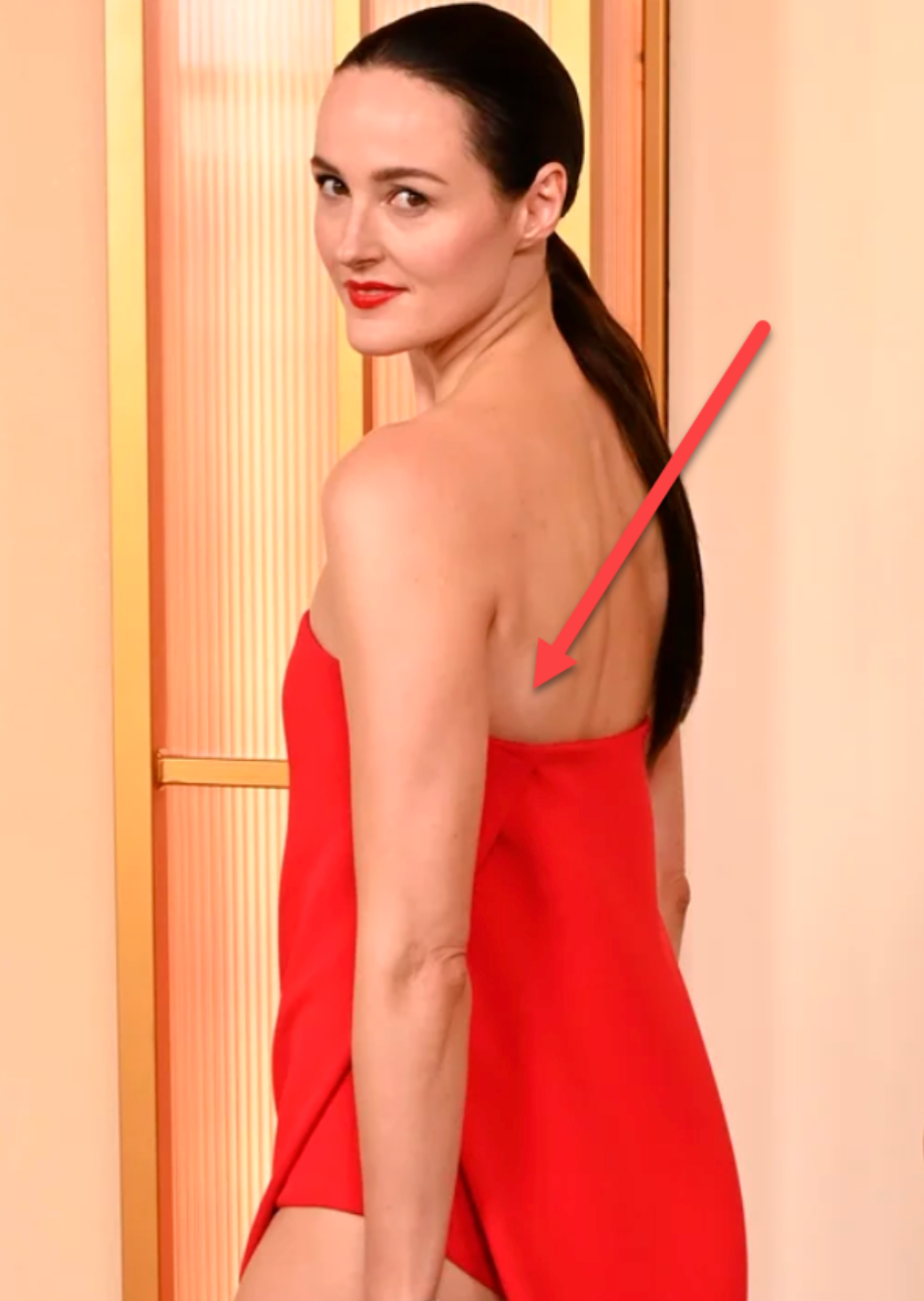
This solution helps redistribute fabric tension and stabilize the construction: the bodice does not simply hold onto the body, but “embraces” it diagonally, creating additional fixation without visible seams.
The upper part performs the function of a support point. It is extra stable — due to the internal corset base, dense fixation, and precise fit. This is necessary so that all the dynamics of the lower part do not deform the silhouette.
For making the inner corset, you can choose any of these courses:

Separate attention should be paid to the geometry of length. The train is calculated so that at rest it lies to the side, and in motion it becomes a continuation of the step. The slightest deviation from these proportions — either shortening or excessive length — destroys the effect: creases, chaotic folds, or loss of form appear.
In the opening high slit, short shorts are visible. The inner corset can either be combined with the shorts into a single jumpsuit or made as two separate elements.

For example, taking a pattern from the course “Draped Wedding Dress On a Soft Base” and building a trouser pattern from the course “The Professional Trousers Pattern Making Course”, you can create a jumpsuit pattern.Cut off seam allowances along the princess seams and leave the pieces up to the waistline. Attach them to the trouser pattern pieces, joining at the waist edge to edge.

For such a jumpsuit, it is important to choose a fabric with directional elasticity: it should stretch vertically and remain stable at the waistline.
Shorten the trousers, model the cup, trace the pattern. The arrow indicates the direction of fabric stretch.

Finally, the choice of material plays a decisive role. A fabric is used that combines weight and plasticity — it must hold the line but also “flow,” not break. Smooth cutting lines without sharp angles enhance this effect, allowing the fabric to move naturally.
For the outer layer, there is essentially no pattern. It is a single piece of fabric cut on the bias, wrapping around the corset base. You can build a pattern, for example, based on the course “Beaded Embroidery Dress”.

Then, after modeling, proceed with cutting. Of course, it is necessary to test the pattern on a mock-up beforehand. Approximately, in my opinion, it looks like this.

The arrow indicates the direction of the grainline.

As a result, what we see is not a decorative technique, but precise engineering calculation. The effect is achieved through the balance of three factors: fabric weight, bias cut, and asymmetrical length. This is a vivid example of a modern approach where form is controlled not by the number of seams or decoration, but by understanding gravity, movement, and material behavior.


