
How to Run a Professional Dressmaking Business: The Complete Guide
There is a moment most dressmakers recognize. You have finished a garment. It fits beautifully. The client is thrilled. And then you sit down and do the maths — the hours, the materials, the messages back and forth, the fitting that ran long — and you realize you earned less per hour than you would have serving coffee.
This is not a skill problem. The work was excellent. It is a systems problem.
Running a professional dressmaking business is not harder than running a casual one. It is different. It requires a small number of habits and tools that most dressmakers were never taught — not because they are difficult, but because nobody in the sewing world ever explained them.
This guide covers all of it. Client process, pricing, contracts, communication, deposits, measurements, referrals. Everything you need to move from taking orders to running a real atelier.

The Difference Between Taking Orders and Running a Business
Most dressmakers start the same way. A friend asks for help with a dress. Then a friend of a friend. Then someone who found them on Instagram. Each request is handled individually, improvised, negotiated differently. Prices vary. Deposits sometimes happen, sometimes don't. Agreements are verbal. Problems are resolved case by case.
This works — until it doesn't. A client cancels after materials have been purchased. A measurement taken three months ago turns out to be wrong and the client expects the alteration for free. A garment is finished and the client wants to change the neckline.
None of these situations are unusual. All of them are manageable — with a system in place before they happen.
A professional dressmaking business has five things a casual one doesn't:
A consistent client process — the same three steps for every order
A signed contract for every order — before any work begins
A non-refundable deposit — before any materials are purchased
Prepared answers for difficult conversations — so nothing catches you off guard
A pricing method — not a guess
That is the whole system. Five things. None of them complicated. All of them transformative.
The Three-Meeting Client Process
The most important structural decision you can make as a professional dressmaker is to standardise your client process into three meetings. Not more, not fewer — three meetings with a clear purpose at each stage.
Meeting One: Design, Contract, Measurements
This is the most important meeting of the entire order. Everything is decided here: the design, the fabric, the price, the dates, the deposit. You arrive prepared — with reference photos that match the client's brief, with your fabric samples, with your order form ready to sign, and with a price you calculated before the meeting started.
You open the meeting by telling the client what will happen: "Today we choose the design, sign the order form, and take measurements. Your fitting will be on [date], and you will collect the finished garment on [date]."
This framing does two things. It tells the client what to expect, which builds trust. And it establishes that you are the professional running this process — not someone waiting to be told what to do.
A few things that must happen at Meeting One:
Use photo references only. Bring 3–5 photographs that match what the client described. No sketches, no AI-generated images — only photographs of real garments. Sketches create expectations that cannot be met. Photographs show what is actually achievable.
Choose fabric from your samples. Do not send the client to a fabric shop. Do not accept fabric they bring from home. You know what works structurally, you know the correct quantity, and you often have access to better prices than a retail customer. Source and quality-check all materials yourself.
Sign the order form before they leave. The meeting does not end without a signed contract and a deposit in hand. More on both below.
Meeting Two: The Fitting
The fitting checks construction, posture, balance, length, and comfort. You check it against the signed order form — not against a memory of what the client mentioned.
Ask the client to arrive with the shoes and underwear they will wear on the day. The height of a heel changes posture, hem length, and corset fit. This is a simple request that prevents the most common last-minute crisis.
If additional work is needed beyond the standard fitting — adjustments that fall outside the original scope — it is quoted, agreed, and paid for before you begin. Never verbally.
Meeting Three: Delivery
The finished garment, pressed and ready, presented well. This is the moment the client decides whether to recommend you.
Make it count. Good light. The garment hung or displayed properly, not handed over in a bag. Give them time to look before you say anything. Most clients need 20–30 seconds to absorb the moment — do not fill the silence.
Hand over written care instructions. Take photographs if you have permission. Collect the balance of payment naturally — it was agreed at Meeting One and stated in the contract, so it is not awkward.
And ask for a referral. The right moment is here, while she is standing in front of a mirror wearing something beautiful: "If you have a friend with a wedding or a special occasion coming up, I'd love an introduction. My calendar fills up fast."
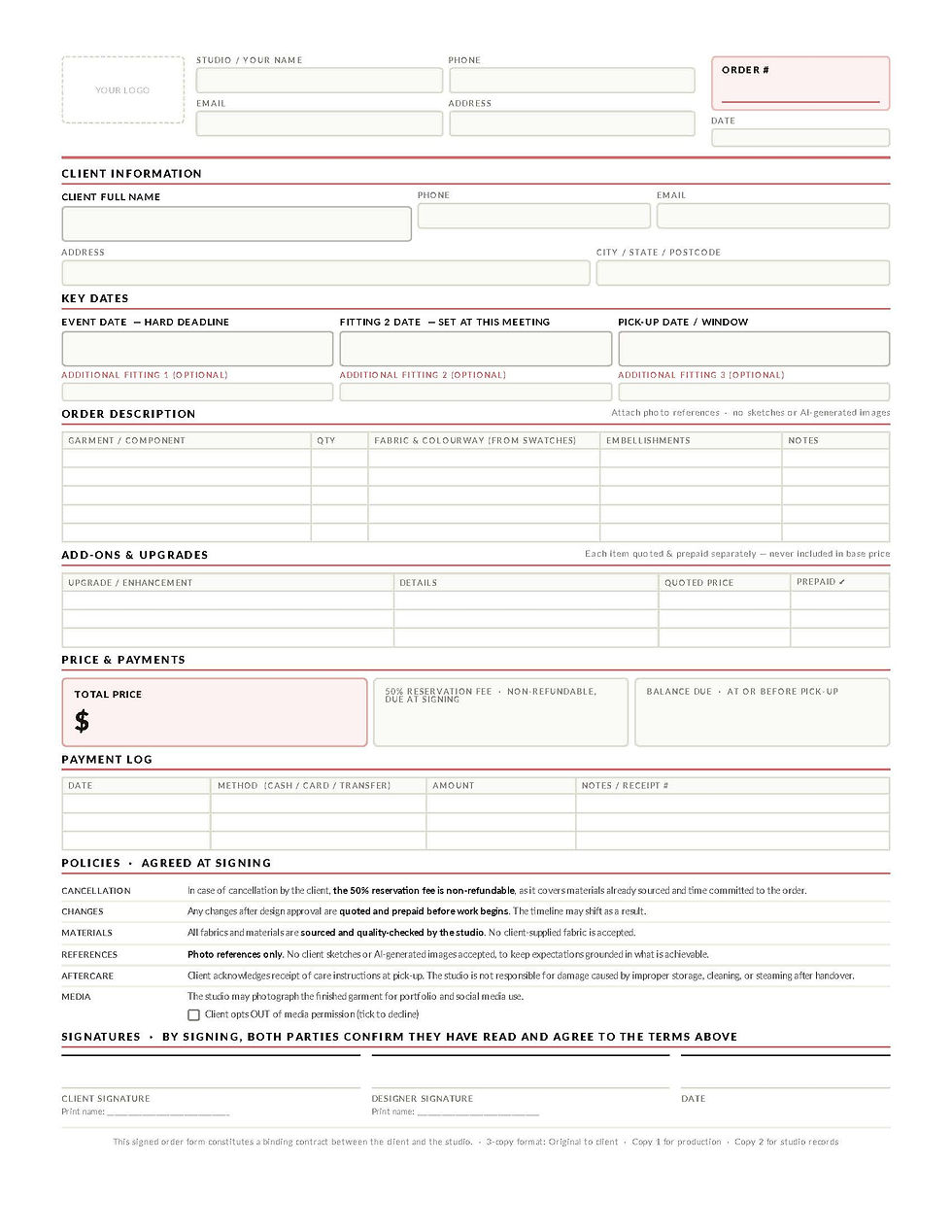
The Order Form: Your Most Important Business Document
Every order needs a signed order form. Every single one. Not because you do not trust your clients — but because a signed agreement protects both of you and eliminates the category of misunderstandings that destroys business relationships.
A professional dressmaking order form covers:
Studio and client details — your name, contact information, and the client's full name, phone, email, and address.
Dates — the event date (the hard deadline), the fitting date, and the collection date. These are non-negotiable once agreed. If the client misses a fitting, that is not your problem to absorb.
Garment description — every component, with quantity, fabric chosen from your samples, and any embellishments. Attach the reference photographs to the signed form.
Pricing — one all-inclusive price covering everything. Not a breakdown. Not "materials plus labour." One number. The client pays for a finished garment, not an itemised list of your costs.
Deposit and payment terms — 50% non-refundable deposit at signing, balance at collection.
Payment log — dates, amounts, methods. A simple record that prevents disputes.
Five key policies:
Cancellation: deposit is non-refundable
Changes: any change after signing is quoted and paid before work begins
Materials: all materials sourced by the studio, no client-supplied fabric
References: photo references only, no client sketches
Media: the studio may photograph the finished garment unless the client opts out
Signatures — client and dressmaker, with date.
Print three copies. The client keeps one. One goes into your production file. One stays in your archive.
Pricing: One Number, Said Confidently
The pricing chapter of a dressmaking business has one rule above all others:
Quote one all-inclusive price per garment. Never break it down for the client.
When you itemise your price — "the fabric is X, my labour is Y" — you invite the client to start auditing your costs. "That seems like a lot for notions." "I found that fabric cheaper online." The conversation shifts from making something beautiful to negotiating a parts list.
Professional dressmakers do not do this. A restaurant does not show you the cost of ingredients on the menu. You pay for the dish. The client pays for the garment.
How your price is calculated
Your price has three components:
Materials — fabric, lining, interfacing, boning, fastenings, thread, and every other consumable specific to this order. The actual cost, not an estimate.
Labour — every hour of your time. Construction, finishing, and fittings. A fitting takes approximately 90 minutes when you account for preparation and post-session adjustments. If you are doing two fittings, that is three hours of labour that must be in your price.
Your labour rate reflects your skill level and your market. An experienced maker in a premium market charges more per hour than a maker just starting out. Neither rate is wrong — they reflect different realities.
Overhead — 20% of your combined materials and labour. This covers your tools, your workspace, your time answering messages, your marketing, and all the work that happens between orders. If it is not in your price, it is coming out of your pocket.
The formula:
(Materials + Labour) × 1.20 = Your minimum price
Your client price sits above this minimum. How far above depends on your market and positioning. The Dressmaking Academy Couture Pricing Calculator calculates all three tiers — minimum, recommended, and luxury — for your specific garment, hours, and country.

When clients push back on price
Every professional dressmaker hears this. A client says the price is more than expected. Here is how to respond:
"I understand — it is a real investment. The price reflects the materials, the fittings, and the standard of finish I work to."
Then stop. Do not explain further. Do not apologize. Do not reduce the price.
If the budget genuinely cannot meet your price, offer to simplify the design: "If the budget is the limit, I can look at a simpler version and give you a different number." The price goes down because the scope goes down — not because you accepted less for the same work.
The 50% Deposit: Non-Negotiable
A 50% non-refundable deposit at signing is the professional standard for custom dressmaking. Not 30%. Not "whenever you can." 50%, at signing, before you order a single metre of fabric.
The logic is simple. Your materials typically represent 25–30% of the garment price. A 50% deposit covers your materials entirely, with money left toward your labour. You are not financing the client's order.
Call it a reservation deposit — not a deposit, not an advance. This language matters. A reservation deposit confirms that the client is serious and that you are holding your time and your calendar specifically for this order.
The order form states it clearly: "A 50% non-refundable reservation deposit is required to confirm the order. In the event of cancellation by the client, the deposit is not returned."
When a client asks if the deposit is refundable, the answer is: "No — it covers materials already sourced and the calendar time I've reserved for you. It's standard for all my orders." Then move on.
Communication: What to Say at Every Stage
Most dressmaking problems are communication problems. A client who does not know what to expect becomes anxious. An anxious client sends messages, changes her mind, and remembers conversations differently than they happened.
The solution is proactive, consistent communication — the same messages, at the same moments, for every client.
After Meeting One (same day): "Lovely to meet you today. Your design is confirmed — fabric: [fabric], lining: [lining]. Fitting on [date] — please bring your shoes and underwear for the occasion. Collection on [date]. Looking forward to making something beautiful for you."
Before the fitting (48 hours prior): "Your fitting is [day] at [time]. Please bring your shoes and underwear for the occasion — about 25–30 minutes. See you then."
Before collection (1–2 days prior): "Your [garment] is ready for [event date]. Come by [day] at [time] — we'll try it on together, go through care instructions, and celebrate the finished piece."
Two weeks after the event: "I hope [occasion] was everything you wanted. How did the [garment] feel on the day? And if you have a friend with a special occasion coming up — I'd love an introduction."
These four messages are the entire communication system. They take three minutes each and prevent the vast majority of client anxiety.
Difficult situations
Client wants to change the design after signing: "I can look at that. Since the design was agreed at our first meeting, any change at this stage is quoted and paid separately — and depending on where I am in the work, it may affect the timeline. Let me see what's involved and come back to you with a number before anything changes."
Client's measurements have changed significantly: "The garment was made to the measurements we recorded and you confirmed at our first meeting. The changes needed to accommodate your new measurements go beyond a standard fitting adjustment. I'll assess what's required and give you a price before I start."
Client wants to cancel: "I'm sorry to hear that. As we agreed in the order form, the reservation deposit isn't refundable — it covers materials already sourced and the calendar time I held for you. If your circumstances change in the future, I'd be happy to discuss a new order."
Measurement Records: Precision That Protects You
A measurement record is not just a technical document. It is a legal record.
When a client signs her measurements at Meeting One, she confirms that those numbers are accurate at that moment. If her measurements change before the fitting and the garment needs significant adjustment, the signed record establishes that the original construction was correct — and that the additional work is billable.
A professional measurement record covers:
Compulsory measurements — bust circumference, bust front, under-bust, waist, stomach, hip, skirt length, and the structural measurements specific to corset work including clip, side length from waist to bust line, and above-bust front.
Supplementary measurements — shoulder strap to waist, back width, waist width front, stomach width front.
Sleeve and shoulder strap measurements — shoulder length, bust height, centre front length, shoulder to shoulder front and back, nape to waist, full back length, armscye circumference, sleeve length, wrist circumference.
Bustier cup measurements — horizontal breast arch, underwire diameter, underwire length, bottom breast radius, vertical breast arch.
That is 43 measurements in total. Each one has a specific purpose. The Dressmaking Academy Measurement Record includes Tatiana's original reference diagrams showing exactly where each measurement is taken — eliminating the guesswork that leads to fit problems.
The record closes with a client signature confirming all measurements are accurate. This signature is your protection.
Add-Ons: The Right Way to Offer More
The base price covers the garment you agreed to make. Everything beyond that is a separate item — separately quoted, separately agreed, and paid before you begin the additional work.
Add-ons that should always be priced separately:
Premium or specialist fabrics in place of your standard options
Hand embroidery, beading, or embellishment
A second garment or accessories — veil, belt, gloves, headpiece
Additional fittings beyond your standard two or three
Rush or expedited production
Present add-ons as a menu, not as a recommendation. The base garment is complete and beautiful as described. The menu is for clients who want more: "The dress is X. I can also add hand embroidery on the bodice for Y, or a matching veil for Z. Each is quoted and prepaid before I begin."
Never offer add-ons as a gift or an upgrade at no charge. When you do, you train the client to expect extras without paying for them, and you devalue the add-on itself.
Referrals: Building a Fully Booked Calendar
A fully booked calendar does not come from advertising. It comes from clients who tell their friends.
This is not magic. It is the result of specific habits at specific moments.
The delivery moment is the highest-leverage moment in the entire client relationship. She is standing in front of a mirror wearing something made specifically for her. She feels beautiful. This is the moment to ask for a referral — briefly, warmly, without pressure.
The two-week message is the most underused tool in dressmaking business. Most makers never follow up after a client collects her garment. Sending a short, genuine message two weeks after the event — asking how it went, whether there is any feedback — is so unusual that it is almost always remembered and appreciated. It also opens the conversation for a referral.
The garment bag with your name on it travels to the venue, hangs in the dressing room, and appears in photographs. A small detail that creates visibility with exactly the right audience.
The compounding effect of these habits is significant. A maker who asks for referrals consistently, follows up genuinely, and delivers an outstanding experience at every meeting typically reaches full capacity within 12–18 months of their first professional order. That is when pricing power shifts entirely to the maker.
Raising Your Prices
When demand for your work exceeds your available time, your prices are below what the market would pay. A consistently full calendar at your current rates is not a sign of success — it is a sign that you are undercharging.
Raise your prices for new clients immediately. No announcement. No explanation. Simply quote the new rate.
For returning clients, a brief note is professional: "My rates have changed from the beginning of this season. For your next order, my pricing will be [rate]. I look forward to working with you again."
Some clients will not return at the higher rate. This is correct. They were clients who valued your work at the old rate — which means the new rate is above their ceiling. The clients who stay are worth more to your business, easier to work with, and more likely to refer other clients with similar budgets.
The pattern is consistent: dressmakers who raise their prices significantly find themselves earning more while working fewer hours, with clients who are more appreciative and less difficult. Higher prices attract better clients. This is not an opinion — it is the mechanics of positioning.
The Free Couture Business Kit
Every system described in this guide is built into the Dressmaking Academy Couture Business Kit — five professional tools available free for a limited time.
The Couture Business Playbook — the 3-meeting client process, finding first clients, pricing strategy, referral habits, and everything else in this guide, structured as an interactive 7-chapter reference you can return to before any client meeting.
Communication Scripts — 23 word-for-word scripts for every moment in the client relationship, with a copy button on every card. First enquiry, pricing conversation, design changes, fitting reminder, delivery invitation, referral request, cancellation, measurement dispute. Every situation you will encounter, with the exact words that work.
Pricing Confidence Card — real market benchmarks by garment type, an 18-item add-ons menu with pricing ranges, the 8 rules of professional pricing, and 6 quick scripts for pricing conversations. Open it before any meeting where price will come up.
Order Form Template — print-ready PDF. Client details, event dates, garment description, all-inclusive pricing with 50% deposit, payment log, five policies, and signatures. Print three copies, sign at Meeting One.
Measurement Record — 43 measurements across four categories, with Tatiana's original reference diagrams. Client signature field included. Print one per client, file with the signed order form.
No credit card required. Instant access. The kit was originally priced at $29 and is free for a limited time.
Frequently Asked Questions
Do I need a contract for every dressmaking order? Yes. A signed order form for every order, regardless of size. Even for returning clients. Even for someone you know personally. The contract is not about distrust — it is about clarity. Both parties know exactly what was agreed, what the price is, what the timeline is, and what happens in the event of cancellation or changes. A verbal agreement remembered differently by each party is not a contract.
What happens if a client refuses to pay the deposit? Do not begin the order. A client who will not pay a deposit at signing is communicating something important: they are not fully committed. The deposit is the confirmation of commitment. Without it, you have no protection if they cancel, and no assurance they are serious. Politely explain that all orders require a reservation deposit and that you cannot begin work without one.
How do I handle a client who wants to supply their own fabric? Decline, clearly and professionally: "I source and quality-check all materials for every order — it's part of how I ensure the finished result meets the standard I work to." The reasons are practical: you cannot guarantee the quality of fabric you did not source, you cannot be certain they bought the correct amount, and you bear the risk if something goes wrong with their fabric. If they have seen a specific fabric they love, they can show you and you can source it yourself.
Should I show clients my cost breakdown? No. Your cost breakdown — materials, labour, overhead — is for your own records. The client receives one price. When clients see a breakdown, they begin negotiating individual line items. You are not selling materials and hours; you are selling a finished garment. Quote one number and stand behind it.
How many fittings should I include in my base price? For most garments, two fittings is the professional standard: one fitting during construction and one final fitting before collection. For wedding dresses and complex structured garments, three fittings is more typical. Any additional fittings beyond your stated standard are priced and agreed separately before they happen.
When is the right time to raise my prices? When your calendar is consistently full. Fully booked at your current rate means there is unmet demand — and unmet demand means your price is below the market clearing rate for your work. Raise your prices until you have a manageable level of enquiries that you can serve properly.
How long does it take to become fully booked? For makers who implement a consistent system — professional pricing, signed contracts on every order, proactive communication, and a referral request at delivery — the typical timeframe is 12–18 months from the first professional order. The system accelerates the process because it produces clients who refer others, rather than one-off orders that do not compound.
Summary: The Five Things That Change Everything
Running a professional dressmaking business does not require years of experience or a large following. It requires five things:
A consistent process — three meetings, same structure every time, regardless of the order size or client.
A signed contract — before any work begins, for every order, without exception.
A non-refundable deposit — 50%, at signing, before materials are purchased.
Prepared communication — the same messages, at the same moments, for every client. Nothing improvised, nothing left to chance.
A pricing method — one all-inclusive price per garment, calculated from costs and market benchmarks, quoted once and held.
These five habits are the entire system. They do not require more talent. They do not require more followers. They require the decision to run your work professionally.
Created by Vladimir Kozorovitsky, co-founder of Dressmaking Academy. Dressmaking Academy offers professional training in corsetry, patternmaking, bridal wear, and fashion business to over 100,000 students across 130 countries. The Couture Business Kit and the Couture Pricing Calculator are free tools available to all registered students.


